Predial Setting in Oceanic®
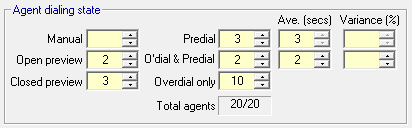
The predial settings on the Extended Properties page (Fig. 1) allow you to specify the average number of seconds before an agent is expected to be free to take a call again. We call this the predial interval.
Because a predial algorithm is easy to implement, they are quite popular but their limitations are not always understood. We have set a maximum level for the predial interval at 12 seconds, which is almost certainly well beyond what anyone needs. And, depending upon your campaign profile, you may find that if you do specify a high predial interval, you will get levels of abandoned calls well in excess of the 5% level.
We don't believe that anyone uses progressive dialing in this way, but have not capped abandoned calls for progressive dialing, because it allows users to get a better understanding of the risks of abandoned calls in this form of dialing.
You will get the same effect by using the predial state only in Cookbook mode.
 How Does Oceanic® Use Predial Data?
Take the simple case of an average predial interval of 3 seconds and no variance. In all cases, Oceanic® will start dialing again exactly 3 seconds before each predial agent is going to be available. In the case of progressive dialing, this will be one call only, and in the case of predictive dialing or power dialing, it may mean dialing two or more calls.
If you have specified a variance, Oceanic® will calculate predial intervals, on a random basis, using the distribution function described by the average value and the variance. Thus a variance of 30% would mean that, with an average of three seconds, the predial intervals in 95% of cases would lie in the range of 1.2 to 4.8 seconds; the remainder falling outside this range.
At a predial interval of 4.8 seconds, the agent is taking 1.8 seconds longer than the average time to finish talk and/ or wrap and be available to take a call again.
Predial in PC-Based Systems
Oceanic® pools dialing and agent resources when it predials (see Progressive Dialing) with the implicit assumption that agents have access to multiple lines for dialing purposes, either in a proprietary dialer, or in a switch or ACD.
This need not be the case. Some agents may have direct PSTN links from their own PCs, allowing them to predial on one line while a call is closing on another. We don't know of any call centers operating on this basis, but if you are, let us know and we will provide you a predial function which is specific to an individual agent, rather than pooled.