Call Recycling Properties
An essential part of most outbound dialing campaigns is recycling or retrying numbers in a calling list. If you don't get through the first time you call it could be that you got a no answer, a busy, the 'wrong' person, or perhaps number unobtainable. Chances are that you'll try again, and if your calls are being controlled by an application then it's probably using some rules to decide when and how often retries should be made.
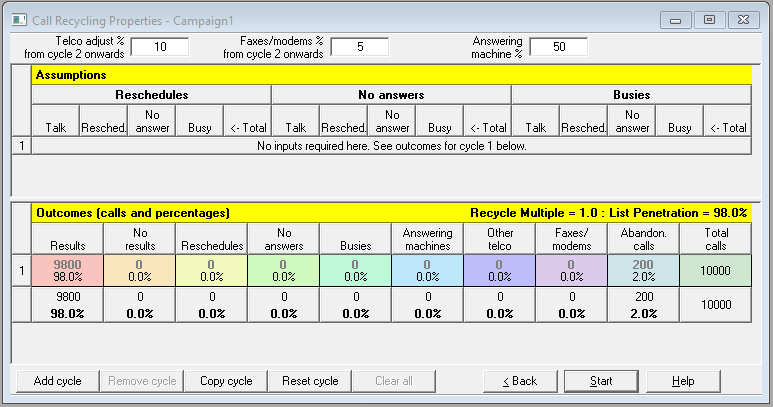
Fig. 1 - Call Recycling Properties
This page has four main purposes:
- to set rules on how often you recycle numbers
- to update the call outcome information already recorded. On the Call Outcome Properties page you record your expectations for no answers and so on, when all numbers in the calling list are called just once. When the recycling page has been filled in, these percentages may change significantly. For example, no answer %s are likely to go up if continual retries fail to get a response. Revised call outcomes are summarized on this page in the Call Outcome Properties section, and used as input to Oceanic®
- to let you expand your call list size as you recycle numbers, and
- to allow you to review progress on a campaign on a regular basis, as you recycle calls. You update your assumptions as you go, based on what you have learned from call outcomes on calls already made in the campaign.
Note
Some of you may have, consciously, or otherwise, encapsulated your recycling thinking in previous wizard pages. When thinking of the size of the calling list and the breakdowns for both talk bands and call outcomes, you may have already allowed for the fact, born of your own experience, that some numbers will be dialed several times. And in such cases, an input for the size of the calling list at say 7,500, in the Campaign Properties page might be used to reflect the fact that you expect all numbers in an actual calling list of size 2500, to be dialed three times each on average.
 CONTACT SYTEL