Call Recycling Assumptions
With due respect to old hands, we recommend that you do try using call recycling to consider how the pattern of call outcomes will vary from one cycle to the next, and that you then evaluate the consequence of this. See also the Note in Call Recycling Properties

Fig. 1 - Call Recycling Assumptions
The starting point is call outcomes in the current cycle, beginning with cycle 1. Three are considered: Reschedules, No answers and Busies. For each of these outcomes, you may forecast what the call outcomes will be in the next cycle. The same three call outcomes are possible, and there is a fourth as well, which we call Talk. This fourth category comprises all live calls except reschedules, and will end in either a Result or No Result, in the call outcomes in the bottom half of the page.
To keep the analysis from getting too complex, we have set some simple rules for dealing with other call outcomes, e.g. answering machines. See Call Recycling Assumptions - Extended for details.
 What Are Cycles?
Each telephone number in a calling list may be 'recycled' i.e. called, a number of times. Each successive occasion, starting with the first can be thought of as Cycle 1, Cycle 2 and so on. Some telephone numbers may be on their 5th calling cycle, while others have only had one. For example, this would be true of busies, which get recycled quickly, as against no answers. This is not always easy to visualize, and Fig. 2 below will give you a good idea of how this works.
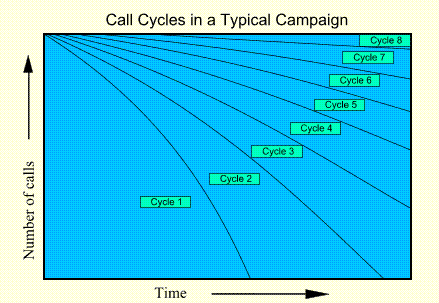
Fig. 2 - Call Cycles in a Typical Campaign
Note how the start points of the lines for successive cycles are grouped together in the top left-hand corner of the graph. And you can see that the call outcomes in any cycle may be spread over many days. The areas in the picture, between any two lines, represent call volumes per cycle, and as you would expect, cycle 1 is biggest, since all numbers are called then. Each subsequent cycle will then be smaller than the preceding one. The actual shape of the curves, and the relative call volumes in each cycle, will of course depend upon the call recycling assumptions you make.
Oceanic® allows you to sum the call outcomes for all cycles, weight them by the number of calls in each cycle, and then compute overall call outcomes for simulation.
To see what you need to do in the first cycle, see Cycle 1.