Revenues and Costs
You can enter assumptions about revenues and costs in both the Forecast by Cycle (Fig. 1):

Fig. 1 - Forecast Financial Controls
...and the Work Scheduler (Fig. 2):
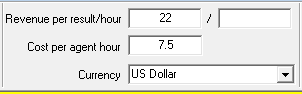
Fig. 2 - Scheduler Financial Controls
The controls in each are linked, i.e. editing a control in one report changes its value in the other.
Entering values here allows you to
- figure out the profitability of a campaign
- determine break-evens
- do investment analysis
The assumptions are
 Revenue
There are two choices for recording revenues:
- revenue per result
- revenue per agent hour
...and you may use either one by itself, or both together.
A common practice in the outbound service agency business (whether in-house or out-sourced) is to charge by the hour, and then keep renewing the contract provided that the service agency delivers sufficient results. These two choices provide for additional flexibility in how charging can be done.
For example:
- an amount of revenue per agent hour might be agreed, enabling an agency to cover their variable costs, and then
- revenue per result might be used to motivate the agency to perform well and earn attractive margins
Cost per agent hour
To give you a true view of profit, your cost per agent hour should be a fully loaded one.
A good rule of thumb is that your agents represent two thirds of your overall costs, and since you are likely to have a good handle on how much you are paying your agents, you can just add 50% to your agent pay costs per hour, to get your fully loaded cost per hour. But don't just take our word for it, check with your financial people!
If you have just upgraded your call center, or if you are having to pay premium rates to attract staff, then this calculation could be quite different.