Normal Distribution
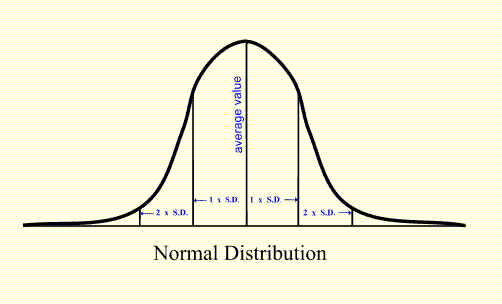
Most call outcome and event data in Oceanic®, which have variable time values, e.g. time to answer, are measured and expressed in terms of the Normal or Gaussian distribution, sometimes known too as the bell-shaped curve because of the symmetrical nature of its distribution. A typical curve with its mean value, and measures of standard deviation (S.D.) might look as follows (Fig. 1):
 Show Example
Take a Talk band with an average value of 120 seconds, as input to Oceanic® for a particular campaign. Let's say you assigned a standard deviation (i.e. variance) of 15% to this value. Now the measurement of one standard deviation, either side of the average value, will encompass 68.3% of all recorded times to answer.
Since 15% of 120 is 18, this means that 68.3% of all talk times generated by Oceanic® for this talk band, will lie in the range of 120 - 18 = 102 seconds, to 120 + 18 = 138 seconds.
Two measures of standard deviation will cover the range of values from 84 seconds to 156 seconds, and these will represent 95.4% of all time to answer values generated by Oceanic®. And the remaining 4.6% of time to answer values will of course lie outside this range.
For some of your inputs, this degree of detail will be a little fussy. But take our word for it - if you are trying to dial effectively at an abandoned call level of 1%, then taking account of talk variance is vital, hence the minimum value of 5% we have set for this.
Note
Many of you reading this will be familiar with inbound simulation, and the use of other formulae, e.g. Erlang C and Poisson, especially for call arrival analysis. Erlang values are not relevant to a true outbound simulation (see the Simulator definition), but Poisson has been used as an option for 'agent arrival' at the start of a campaign. .
Those of you with a statistical background may be interested in why we don't offer other distribution functions to describe events, and why no measures for skewness and/ or kurtosis. There are two basic reasons:
- statistical relevance
- ease of comprehension and use on the part of the majority of users
But if any users would like us to incorporate other distribution functions, we will be happy to hear from you, with reasons why.