Definitions and Glossary
 Introduction
Do you ever get frustrated at not knowing what people are talking about when they use terms such as predictive and power dialing? And then you visit a selection of vendors, and your mind is in a whirl, as you try and compare the claims made by each, and why it is that their way of allocating calls to agents is the best!
We talk to a lot of people about outbound dialing, especially in North America and Europe, and we know that there is often little agreement or common understanding on either what to call the key functions in outbound dialing, or indeed on what they are.
In order that you may make sense of Oceanic®, we have had to set out our definition stall. Where possible we have used standard definitions, common in the call center industry. Our interpretation of what is common is based on both dictionary definition and also what we have observed as common usage, in discussions we have had in the industry. An example of this is the definition we have adopted for predictive dialing.
In other cases we have developed our own definitions, not for the sake of it, but in order to explain the choices open to you in Oceanic®, mirroring the options you should expect to find available in real life. See especially
If you refer to the table of contents, you'll find that many of the definitions used in Oceanic® occur naturally as part of topic descriptions. Definitions for which there was no obvious home are set out below.
Tip
An extremely useful compendium for getting to grips with some of the terminology in the world of call centers and telecoms is Newton's Telecom Dictionary (published by Flatiron Publishing, New York City). It is also an authoritative tome that helps you read between the lines of what's happening (or not) in the industry.
The terms
ACD
ACD stands for Automatic Call Distributor. Started out life as a specialized telephone device whose primary function is to handle bulk inbound calls and intelligently route them to dedicated agents or services. Now frequently used for automating outbound calls as well.
Agent Name
To make the simulations realistic, we have compiled a list of agent names which we use to populate campaigns on a random basis. Any similarity to names of real people you know is purely a chance event, and is not intended.
If you run the same campaign again, without making any changes to your data, you may see the same names appearing in the Agent Summary.
Auto Attendants
Just as dialers may encounter a lot of answering machines in dialing consumers, so too will they encounter machines in dialing business numbers. These will include not just answering machines, but auto attendants as well.
An auto attendant is a catch all for a device that answers a company's phones and allows a caller to select a service, dial an extension, leave a message or select a recorded announcement of the caller's choice.
Average
This term is used within Oceanic® to describe the arithmetic mean for a class of events, obtained by adding up the time for all events in the class, and dividing it by the number of events.
Busies
On the Call Outcome Properties page, these outcomes are one of a number of telco messages, in this case indicating that activity is taking place on the number dialed, and the call cannot be connected. Oceanic® isolates busies from all other telco messages, and treats them as a separate class of call outcome.
ISDN services will provide an event code that should allow a dialer to immediately recognize busies and terminate the call in milliseconds only, in which case no detection time is required. If the PSTN returns a tone instead, then a dialer may need up to several hundred milliseconds for detection. If the call is being put through to the agent, then detection time is likely to be around a second.
Call Blending
There is a lot of hype about it. Technology may deliver, but can agents hack it? Outbound dialing may well be something that agents do when the inbound calls go away, but read what one of the leading commentators in the market has to say.
"in 1993....it appeared that call blending would be the next great wave to sweep over the industry and radically improve productivity. In a blended calling environment, technology allows agents to switch from inbound to outbound calling during lulls in inbound calls, or vice versa. The concept was great, but it didn't work well for some companies, either because they paid more attention to price than multifunctionality in their technology purchases or they did not thoroughly understand how to handle their human resources in the blended calling environment. For example some companies hired inbound agents, provided inadequate training, and expected them to succeed in outbound. These companies failed to take into account that outbound selling is a totally different animal than inbound selling: it takes a different personality to sell effectively outbound. Thus if you hire inbound agents without testing them for outbound selling proclivities, the agents are doomed for failure"
Extracted from Publisher's Outlook in 1996 Buyer's Guide published by Telemarketing and Call Center Solutions magazine.
This is a very sensible warning, whose words need to be heeded. It's not saying that call blending doesn't have a place. Clearly with the right agent selection and training it does and we expect Oceanic® to be used in conjunction with inbound work management packages, to help call blenders balance their agent numbers and workloads.
So how will this happen?
As it stands, Oceanic® can be easily used to input details for the number of agents, as they switch between inbound and outbound activities. The imperative, from a customer viewpoint (in order to meet inbound service levels) to run campaigns on a half hourly basis probably doesn't exist, though you can if you wish to. A better approach in most call centers may be to consider the time period over which outbound activities will take place, and average all your campaign details, to allow you to produce a single outbound work schedule for that day.
We will consider providing an automated link to inbound packages to capture agent numbers and other data, if there is sufficient demand.
See also Work Scheduler - Fine Tuning Tips.
Called Party
This term is used to denote a person who has picked up the phone and responded to an outbound call.
Call Progress Monitoring
In olden days, with manual exchanges, you cranked a handle which put you in touch with an operator at the exchange. You would indicate the number you wanted dialed, and then stay on the line, until the call got through, or was unsuccessful. During this time the operator monitored the call, to check on its progress.
You will find the term used in a slightly different sense in today's outbound dialing world. Dialers, including voice modem cards in PCs will listen in on a call that they have dialed, and once they get a response, will attempt to detect and screen out most call outcomes that are not live calls. You will often find this term used as if it applies to the detection and screening process only, whereas it is both this as well as the time leading up to it, when the dialer is waiting for a network response.
Campaign
A campaign consists of a calling list of telephone numbers to be called by a group of agents in a call center. For dialing methods other than manual, scripting aids and screen-popped data specific to each number will assist the agent to have a productive conversation, when a live call is made.
Most call centers will run multiple campaigns at any one time, and it makes good sense to ensure the data in each campaign is reasonably uniform.
For example:
- A sales drive on scuba diving holidays to members of water sports associations
- A customer care program welcoming new subscribers to a cable TV network, and checking that the service meets their expectations
Putting these kinds of data into a single campaign is rarely something that a supervisor will choose to do, for reasons that are fairly obvious.
However there is one reason, that may be less obvious, which is very relevant to good dialing performance if you choose predictive dialing.
These two groups of consumers may well have quite different stay at home tendencies. The first group will be sporty, maybe on the move a lot, and perhaps rarely at home to take a call. Whereas the second group may have a strong couch potato element, and consequently generate a much higher live call rate. (No offense intended to telly addicts). So mixing both types of consumer in a single campaign could lead to wide variations in your call outcome distribution, which should be avoided, if possible.
Campaigns may be run over several days, or perhaps many weeks/ months. Depending on the context, we have sometimes used the term shift to denote a particular session or day in the life of a campaign.
Campaign Length
The length for any campaign can be expressed in terms of either time or the size of the calling list to be processed.
The calling list size ranges from a minimum of 1000 calls to a maximum of 10 million calls. Note that recycling may mean that by the time a campaign has been completed, a calling list has been recycled a number of times, with the actual number of calls made, being several times the size of the calling list.
See also Min/ Max Values for time limits.
Campaign Name
Campaign names are unique. If you already have a campaign running, or saved, then you may not use the same name for another campaign.
Close
An agent has finished talking to a called party and has also completed any work updating their details on the agent screen. At this point the host application will either make the agent available to receive another call, or make him unavailable.
Connects
The term connects is sometimes used to refer to all calls that are put through to an agent. Some answering machines may be detected by a dialer and thus be non connects, and some will reach an agent and thus be connects. And in the case of a manual agent all calls will be connects, i.e. connected to the agent, leaving the agent to detect and terminate all outcomes, other than live calls.
Don't mix this use of the term connects with what happens at the other end of the line when a call is dialed and a 'connect' may be made to an answering machine. In other words, Oceanic®'s use of the term is agent-centric, not Called Party-centric.
Control
A control is defined as anything that you can click on in the Campaign Wizard to cause something to happen. Examples are
- all buttons, including radio
- check boxes
- editable cells
Detection by Agent
This is a state in respect of busies, other telcos and machines, when the agent (and not a software application), is responsible for detecting a call outcome and terminating it. See Call Outcome Properties.
Dialer
In Oceanic®, a dialer is any telephony device which dials numbers on behalf of agents, and (in most cases also) screens call outcomes which are not live calls (but see especially Answering Machine Detection) using either detection methods specific to itself, or call outcome information provided from the PSTN.
Historically the term has meant just standalone predictive and power dialers, or autodialers connected directly to the PSTN. Outbound dialing and call outcome detection are increasingly becoming integrated into company networks where applications and ACDs talk to each other, and the term dialer covers these situations as well.
Dialing Cycle
The dialing cycle is the period of time from when an agent or a dialer begins to dial a number, until a call outcome is known. An outcome will be either a live call, or a decision by either the agent or a dialer to terminate the call and free up resources to dial another number. There are up to four elements in the dialing cycle, in sequence as follows
| Dialing element | What happens | |
|---|---|---|
| 1. | Setup | The timing for this element begins when the dialer receives a make call message with the digits to be dialed, and it ends when the network receives the digits. Manual dialing will of course take a few seconds, and so too may modem-based dialing from a PC. It's worth doing a few tests to check out these values, in your own particular case. For all dialing methods except manual and PC-based ones, the setup time may be milliseconds only, and if so can be ignored. But if dialing out is being done using a key-based system, and perhaps too for some Centrex services, several seconds could be involved in setup. |
| 2. | Network | The dialing digits have entered the PSTN.The appropriate number has been called, a response obtained and passed back to the dialer. For a modern PSTN, especially ISDN, this time is of the order of a second. If you have lots of other telco call outcomes such as number unobtainable or network busy, you may want to consider upping the network time, if a lot of retries are being made by the network. This time is combined with the dialing setup time on the Setup and Talk Properties page |
| 3. | Ring | In most cases, the response will be a ring tone, waiting for a person or a device to answer. The exceptions are busies and other telco messages such as number unobtainable, for which this phase is skipped. |
| 4. | Detection | Once a reply is received, following the ring phase, call detection may then be used to determine the type of call outcome. This detection may be done by an agent or a dialer. If there is no connect then unless the call is treated as a no answer, either a busy or an other telco message will be received. Detection may also be applied to these in the case of a dialer using analog lines. |
The first two of these are recorded on the Setup and Talk Properties page - Setup Times.
And the last two are recorded on the Call Outcome Properties page.
The values we have used in the Examples can be used as a guide to get you going, but it's worth spending some time up front to be sure that you put together an accurate assessment of your own dialing cycle.
Dialing Resources
Oceanic® allows users to calculate what dialing resources will be required to support an outbound campaign. These resources are of up to two kinds.
- The first is trunk lines which will always be required.
- On the more advanced campaigns when a dialer is managing the dialing, then a second resource will usually be required. We have chosen to call these resources ports. Their main function is to do call progress monitoring. See the diagram below showing how Oceanic® records the use of both trunks and ports from the time that a call is initiated.
Fig. 1 - Dialing Resources
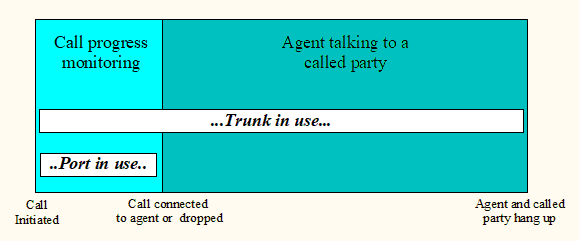
The timing of the activation and release of both ports and trunks on particular dialing platforms may vary slightly from the assumptions that Oceanic® makes.
DSP
This stands for digital signal processor/ processing. It's what proprietary dialers have done for years to process analog signals and figure out what the call outcome is. Many ACDs as well now have this technology as integral to their switches.
See also Answering Machine Detection.
Event
Oceanic® is an event driven system, managed by the Virtual Event Machine (VEM®). It balances the interaction of the complete range of events that occur in an outbound dialing environment, and allows for any uncertainty in event classes and times. There are two main classes of events:
Event Times
Event times are expressed as averages with, in some cases, variances as well.
Some of the variances that we ask you for in the campaign wizard, will not be very significant statistically, but we've put the logic in to handle them anyway, so you can be the judge. If you have run many campaigns, and are sure that certain variances are having minimal impact on your conclusion, then you can enter a default value of zero if you like, but not for talk times, where the minimum allowable figure is 5%.
The variances measured are in the form of standard deviations. See Normal Distribution for an example of how they are measured. This is a perfectly adequate way of looking at event patterns for just about any campaign you can dream up, and in the case of talk and wrap times, we've given you the option of specifying up to five discrete distributions for the same campaign.
Fax/ Modem Adjustment
This percentage is used to reduce the incidence of telco events when call recycling is used.
See Initial Settings and Call Recycling Outcomes.
Host Application
The host application is the software that sits on a server in real life providing the dialer with telephone numbers to dial, and screen-popping information and scripts to agents, as live calls are made.
ISDN
This term is short for Integrated Services Digital Network. When such circuits are available, this is usually the recommended method for making outbound calls.
No Result
An agent has made a call, failed to achieve his objective, and judges that there is no point retrying this telephone number again during the life of this campaign. See especially Talk/ Wrap Bands.
Non Connects
The term non connects is sometimes used to refer to all calls made that get terminated before they reach an agent. Some answering machines may be detected by a dialer and thus be non connects, and some will reach an agent and thus be connects. And in the case of a manual agent all calls will be connects, i.e. connected to the agent, leaving the agent to detect and terminate all outcomes other than live calls.
Don't mix this use of the term non connects with what happens at the other end of the line when a call is dialed and a 'connect' may be made to an answering machine, but the call is then terminated by a dialer, making it a non connect as far as the agent is concerned. In other words, Oceanic®'s use of the term non connect is agent-centric, not called party-centric.
Pacing Algorithm
A term used to describe the software in a predictive dialer, which determines the basis on which to dial.
Normally refers to overdial algorithms but may also be used to refer to predial algorithms as well.
Port
The dialing resource that most people easily identify with when thinking of outbound dialing is trunk lines. Another type of dialing resource will often be required as well, and we are going to give it the name ports.
The primary function of a port is to do call progress monitoring in order to determine the call outcome. Ports may comprise software only, or be both hardware and software.
Port usage is a lot less intense than trunk usage. If call progress monitoring is being done by a dialer, then as soon as a call is initiated, both a trunk and a port will come into use. The port will (should!) stay in use only until either a call outcome is detected, or a call is put through to an agent. It will then be released. See Dialing Resources for a schematic of this.
If you are working with a dialing platform that doesn't have a 'make predictive call' facility, then the calculation of ports done by Oceanic® won't just apply to call progress monitoring requirements, but also to any additional dialing ports required to make the call, during the call progress period.
Predial Interval
The predial interval is the average number of seconds before an agent is expected to be free to take a call again. Oceanic® allows a maximum value of 12 seconds. It is used in progressive dialing and can also be used to supplement performance in predictive and power dialing.
See especially Comparing Overdial and Predial.
Preview Dialing
Preview dialing is when an agent 'previews' details for the next telephone number to be called by or for him. Oceanic® distinguishes between two kinds of preview state as follows
Open Preview
The agent is previewing but dialing has not yet commenced. Oceanic® sets no time limit on this state. Open preview is the normal dialing state for simple preview, and often for manual as well, but call center managers may want to give their agents the ability to do this on all types of campaigns.
Oceanic® gives you the opportunity to do just this, by making open preview available to all other dialing methods as well. All you do is specify the number of agents you want to work in open preview mode. See Agent Dialing State and make sure that you set a time for it on the Setup and Talk Properties page.
The term 'open preview' has been particularly associated with the use of autodialing. We have defined two methods of auto dialing,
- simple preview - characterized by what we have called the open preview dialing state
- auto preview - takes place in the closed preview dialing state only
Closed Preview
Once dialing has commenced, any agents in open preview mode, move immediately into closed preview mode, and continue viewing details for the telephone number being called, until a call outcome is achieved.
Closed preview is the normal mode, or, if you like, starting point for all agents on an auto preview campaign, i.e. as soon as an agent is available, details are screen-popped, dialing commences and agents begin closed preview.
What about predictive, power and progressive dialing?
Normal dialing state for these other three methods is no preview dialing at all. The idea is that trained agents and smart scripting can often eliminate the need for preview activities, and you can get more calls for your buck, since you will be able to invoke the overdial and predial algorithms that these dialing methods employ.
If you place agents in both preview and overdial states on the Extended Properties page, then Oceanic® will effectively run two campaigns within one; one for preview agents and the other for predictive agents (denoted by the overdial state). The reporting of the abandoned rate, when you run the campaign, will be for all agents. Thus the greater the proportion of preview agents, the more will the recorded abandoned call percentage understate the target you set.
PSTN
Public Switched Telephone Network
Real Time Mode
If you run a campaign in real time mode, Oceanic® will process events in the times specified in the campaign wizard. So if the average talk/wrap time for all talk bands is two minutes, you'll literally wait an average of two minutes, before an agent position updates in the Agent Summary to show a completed call.
Reschedule
A live call is made, and an arrangement is made to call back at another time when either the right person is expected to be available to talk to, or the called party is free to talk.
See especially Talk/ Wrap Bands and also Call Recycling Properties.
Result
An agent has completed a live call and has been successful in his objective for it. See especially Talk/ Wrap Bands.
Scripting
Scripting systems are essentially online help dialogs that guide an agent's responses in a live call. For example, if a called party says that they can't talk now, and could the agent phone back later, a script might give the agent a number of responses to select from in reply, perhaps including "it'll only take a minute of your time."
There's no doubt that good scripting has had a significant impact on productivity in outbound calling. If you are seeking to improve your outbound operation, don't just get hung up on some of the advanced dialing methods looked at by Oceanic®, check out what good scripting can do for you as well.
Search process
If you are dialing predictively, it will take a number of seconds (depending on your processor speed) to work out the right dialing balance for your campaign, once you have filled in the Campaign Wizard, and started Oceanic®.
See also Dialing Under Extreme Conditions
Simulator
The software engine that drives Oceanic® is an event-driven simulator that we have designed specifically for the call center market, called the Virtual Event Machine (VEM®).
Compare this with the experience some of you may have with most inbound management tools, which rely upon Erlang tables to generate inbound call data. Erlang tables make assumptions about caller behavior, such as that all callers always stay on the line until an agent answers. So the tools that use them are models (i.e. best estimates, and often very good ones at that), rather than true simulators.
Special Information Tones (SITs)
This term, or SITs for short, is used in North America, and sometimes elsewhere, to describe the different tones returned to a dialer when a connection cannot be made with a telephone number; examples are busies and number unobtainable. Oceanic® treats all busies as a separate class of call outcomes in their own right; all other SITs are classified as other telco in Oceanic®.
Talk
This denotes a state when an agent is talking to a called party. Most outbound operations will aim to maximize talk time, expressed as the number of minutes in the hour spent talking.
Telco Adjustment
This percentage is used to reduce the incidence of telco events, except busies, when call recycling is used.
See Initial Settings and Call Outcome Properties.
Time to Answer
Once a telephone number has been dialed and network connection established, the time to answer measures the average time it takes for a called party to then pick up the telephone receiver. This value is expressed in seconds, and has both an average value and a variance. See Normal Distribution for an understanding of these two measures.
Oceanic® will flash a message up asking you to reconsider, if the average time to no answer is not at least 50% greater than the average value for time to answer.
Time to No Answer
The time to no answer is used to set a cut off point on dialed calls for which there is no answer. The variance cell associated with it on the Call Outcome Properties page is enabled for three dialing methods only; manual, simple preview and auto preview, and the Cookbook.
If you are using the Cookbook, any variance you enter will be applied to the manual and open preview states only. In the more automated forms of dialing, the time to no answer will be set by a supervisor, outside of agent control, and will be a fixed value, with no variance.
If you want to simulate two phases of a campaign, with time to no answer being reduced/ increased at some point, then the best way to do this is to run the same campaign details twice, with the different values.
Oceanic® will flash a message up asking you to reconsider, if the average time to no answer is not at least 50% greater than the average value for time to answer.
Trunk Line
An outside channel or line connecting to the PSTN from a call center, enabling a connection to be established between a dialer and a called party.
Variance
The word 'variance' is used throughout the Wizard to describe the distribution of values, around an average point, for a specific parameter e.g. talk time. In all cases the measure of variance used is the standard deviation of the average value specified. See Normal Distribution for detailed discussion.
Our apologies to the mathematically inclined who will know that in normal distributions the standard deviation is the square root of the term 'variance'.
Virtual Event Machine (VEM®)
The Virtual Event Machine, (VEM®) is the specialist software that Sytel has created to drive Oceanic® . It has three distinguishing characteristics:
- The first and most important one is that it doesn't so much model the real world, as mirror it. The precise data that you specify in the Wizard is used to create the actual call outcomes that Oceanic® displays in its campaign output.
- Secondly, unlike more general purpose simulators, designed to serve wider markets, VEM® has been designed for the call center market and honed deliberately for maximum speed, without any sacrifice of accuracy. So if you are running a campaign which shows say 5 million call attempts a minute, then the data associated with each call attempt such as likelihood of a live call, or time to answer, together with the variances in them, are being derived and applied from the assumptions that you made in the Wizard, literally at that speed.
- And, because of its design, VEM® is able to perform complex mathematical tasks quickly, and find the optimum solutions for issues such as balancing wait times and call abandonment rates, or deciding the right number of agents to staff a campaign.
Wait
Traditionally this is defined as the measure of time from when an agent becomes available to take another call, to when a call is connected to him. Connects to agents may be any kind of call outcome in the case of manual dialing; otherwise they will depend on the extent of dialer detection being done. If no answering machine detection is being used, and there is a high proportion of answering machines among call outcomes on a predictive campaign, the dialer will (should!) increase its dialing rate to allow for what is effectively a high proportion of short talks, and the wait time between all call outcomes should fall.
In this help file we have talked about talk and wait times moving in different directions in response to changes in parameters and dialing efficiency. However the surge of answering machines in many calling lists, combined with answering machine detection being undertaken by the agent, can mean that talk time per hour, and wait time measured in seconds between connects can both move in the same direction.
Wrap
Usually this is when an agent has finished talking to a called party, but is still updating their details before becoming available to take another call. Sometimes called closing, wrap-up or wrap time.
Also included within this definition of wrap is the time taken by the agent on record updating, for all events other than live calls, after the agent (and not a software application) has detected the type of call outcome and terminated it. For example imagine that an agent has just terminated a connect to his headset that was an answering machine. The time taken subsequently to update the record with the follow on action and any comment, is all treated as wrap.
Wrap following a live call is recorded on the Setup and Talk Properties page. All other wrap is recorded on the Call Outcome Properties page.