Dialing Rules
This section provides a basic guide to dialing rules. For an up-to-date view of any particular country, contact Sytel.
Rules governing outbound activities differ considerably amongst countries.
- In some countries e.g. Germany, business to consumer calling is not permitted at all, without the prior consent of the called party.
- In other countries e.g. the USA and the UK, prior consent is not required, but those who don't want to be called can ask to have their details recorded in Do Not Call (DNC) lists. In the USA this arrangement is covered by Federal legislation (The Telephone Consumer Protection Act); in the UK it is code of practice only, laid down by the UK Direct Marketing Association.
The main thrust of these rules is to set out how telephone calls should be conducted, for example how to introduce yourself, and indicating the purpose of your call, and are ones that you as users should already be familiar with in your own country. If you are not, then you should contact your local direct marketing association for details.
If you are going to use the more advanced dialing methods in Oceanic® (predictive, power and progressive dialing) then you also need to be aware of a class of rules, we will call dialing rules. These may not always be explicit within any existing codes of practice, or national laws. If you don't already know what these rules are in your territory ask your local direct marketing association, or your national/ state regulatory body on communications. And if they don't know or have any views, talk to a local predictive dialing supplier.
These rules, and their relevance in Oceanic®, are as follows:
 Abandoned call delay
This is the time taken in the more advanced dialing methods before connects are abandoned when no agent is available. This is a global setting in Oceanic®, available by selecting Abandoned call delay... from the Options menu (Fig. 1), and may have any value between zero and 5 seconds.
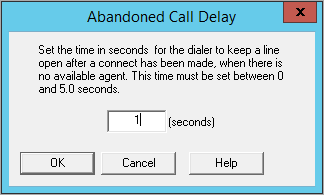
In Oceanic® this time will be added to the time required for detection. In the US guidelines the maximum allowed for these two times together is 2 seconds. So for example if it takes two seconds to do call progress, and no agent is available when it is complete, then in the US the guidelines oblige a dialer to hang up immediately.
We have used a delay time of just 1 second in the demonstration and the examples.
Predictive Hangups
A dialer hangs up on a ringing call, before a reasonable time has been allowed for a person to answer.
The US DMA have achieved a world first in restricting this practice in requiring that 'the predictive dialing system ring at least four times or for 12 seconds before disconnecting.'
Oceanic® does not allow predictive hangups.
Note that the time to no answer (the point at which the dialer is deemed to hang up on an unanswered call) must be at least 50% greater than the average time to answer.
Abandoned call limits
On the Extended Properties page of theCampaign Wizard, Oceanic® allows you to specify a target anywhere between 1% and 5% for predictive dialing. There are few countries or states setting maximum limits, but good practice in all major markets is now within the range we are using. If the rules or practices in your market are looser than this, or there are particular reasons why the maximum level should be higher in a particular industry vertical, then tell us about it, and say why we should extend the limit in this instance.
Calculation of abandoned call rate
The Options menu Oceanic® offers two options for measuring abandoned calls. They can lead to quite different dialing rates, and you must check out which applies in your state/ province/ country.
We have researched rules in some of the top territories in the world for outbound calling, namely:
We will add to this list in future releases. If your country is not included and you have dialing rules we'd be delighted to hear from you.
Sytel has written extensively on dialing rules and compliance issues. See the Sytel website.
Warning
If you want Oceanic® to do you justice, it is really most important that you spend some time deciding what dialing rules are appropriate to your circumstances.
And if you are comparing dialers or deriving an efficiency measure for your own dialer then you must use the same assumptions for dialing rules, in each case. See especially the section on Performance Issues.