Standby Agents
Use of a standby agent is triggered when Oceanic® wants to put a call through to an agent, but none is available to take it, and there is no scope for call abandonment (i.e. if the call were then abandoned, this would cause the recorded cumulative percentage of abandoned calls to exceed the maximum level of abandoned calls (including zero!) specified on this page).
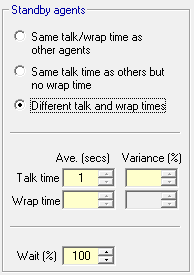
The Standby agents controls on this page (Fig. 1) are enabled if you have chosen either:
- the power dialing method, or
- the Cookbook method, and
- put at least some agents into an overdial state (in the Agent Dialing State section of this page)
 Talk/ Wrap selection
Standby agents may be in a position to handle calls on the same basis as the agents logged into the campaign. If this is the case, you may choose to assign
- the same talk/ wrap time as other agents, or
- the same talk times only, and ignore wrap time, on the assumption that even if some wrap is required, it would not stop an agent being on standby again effectively at the end of the talk stage, or
- you may choose to select a quite different talk/ wrap band, assigning average duration and variance to each. The expectation is that standby agents will have a brief talk/ wrap, probably taking seconds only to qualify, convey key information, or set up a retry.
Wait (%)
Standby agents may be literally 'standing by' or engaged on other productive work, or perhaps both. You can use the Wait percentage to allocate standby time for an agent between the wait and the not ready states on the Agent Summary. At 100%, all standby time will be recorded as wait time. At anything less than 100%, standby time is allocated between wait time and not ready time. For example if you specify a figure of 90%, then 90% of standby time for each standby agent will be shown as wait, and the remaining 10% will be shown as not ready time.
Impact on call recycling
Oceanic® measures the time spent by each standby agent on a campaign, and shows this on the Agent Summary, where the purpose, insofar as standby agents are concerned, is to show how many will be required for the campaign, given the data you specified on this page.
When you first run a campaign, you won't know what proportion of live calls will go to standby agents, and if it is more than say five per cent, you may want to go back and change your call recycling data to reflect the impact of calls being diverted in this way.
- In the first place, if the standby agents are handling calls in the same way as the agents logged into the campaign, then you may want to adjust the percentage for the Results talk band upwards, on the Setup and Talk Properties page, to compensate for their success. Otherwise it will be unrecorded when you go to the Forecast by Cycle report, or use the Work Scheduler. You can do this by considering the proportion of live calls going to standby agents in the Agent Summary.
- Secondly, if standby agents are only responsible for making appointments for one of the campaign agents to call back, then, calls which would otherwise be results or no results, will be reschedules instead on the Call Recycling Properties page, and you should adjust these three assumptions accordingly, giving more weight to reschedules, than you would have done, without standby agents. And the basis for doing this is again by considering the proportion of live calls going to standby agents in the Agent Summary.
Impact on Work Scheduler
When you consider the number of standby agents appearing on the Agent Summary, you simply have no way of knowing at what point in your campaign, the maximum number recorded will be required. In theory, this could be at any time, in which case you might always plan to have the number shown on the Agent Summary available. This is not a very effective way of working, unless standby agents are shared across more than one campaign. It's also a reason why predictive dialing has been seen as a more effective dialing method by many users.
Predictive dialing and standby agents
Oceanic® disables the standby option if you have chosen predictive mode. This is to save confusing users who are not used to associating standby agents with this dialing mode. But it may not be an unreasonable thing to do in practice, and we would be interested in hearing from anyone whose predictive dialer operates in this way.